
Let me be blunt: most AI writing tools are disappointments.
I’ve tested dozens – from expensive enterprise suites to clever prompt bundles. They’re great for blog outlines, marketing copy, or sparking ideas. But when it comes to the one thing creators need most – consistent, long-form narrative generation – they fail spectacularly. The “memory gap” isn’t just a limitation; it’s a deal-breaker for anyone serious about building intellectual property.
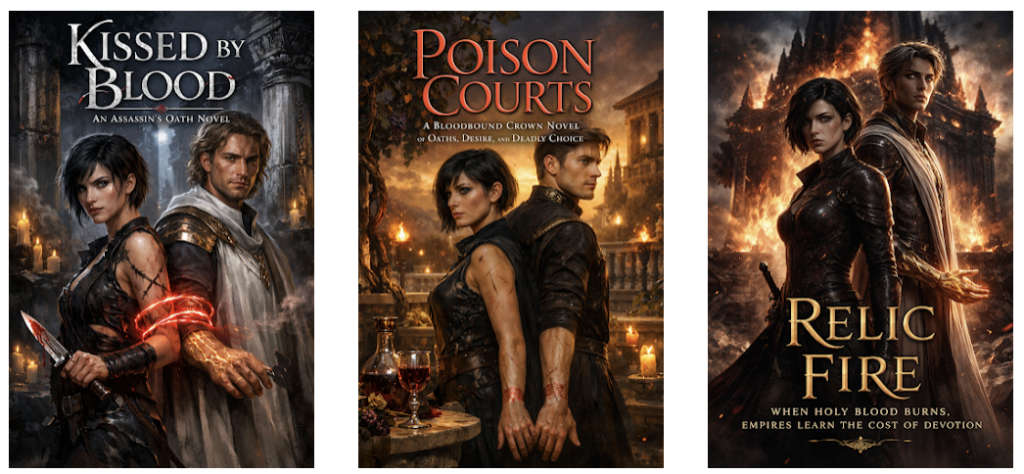
That was my position six weeks ago. As someone who’s built multiple digital businesses, I recognized the Romantasy gold rush for what it is: a perfect storm of voracious readers, scalable digital products, and creator-friendly platforms. But trying to capitalize with standard AI tools felt like trying to build a skyscraper with sand. Every promising chapter three would collapse into plot holes by chapter five.
Then I tested 336 Prompts for Complete Romantasy Sagas, and my entire perspective shifted. This isn’t another prompt collection. It’s the first legitimate operating system for AI-powered franchise creation I’ve encountered.
The Architecture That Changes Everything
What makes this system different isn’t the quantity of prompts – it’s their engineered function. Most prompt packs give you fishing poles. This one gives you a fully-stocked fish farm with automated harvesting equipment.
The magic happens in three interlocking components:
1. The Canon Vault Generator
The Universe Seed prompts (all 336 of them across 42 tropes) don’t just suggest concepts. When executed, they force ChatGPT to generate a comprehensive “Saga Canon Vault” – a binding narrative constitution that includes:
- Hard magic systems with documented costs and consequences (no free power)
- Nine-book relationship progression arcs that maintain proper slow-burn pacing
- Political and factional histories that evolve logically across decades
- Character bibles with wounds, desires, and growth trajectories
This single output replaces what traditionally takes authors 3-6 months of planning. I generated a complete “Bloodbound Crown” saga bible in under two minutes. The specificity was staggering – from the scent of poison-vat air in guild halls to the exact political consequences of broken blood oaths.
2. The Memory Bridge
This is where the system solves AI’s fundamental weakness. The included “Canon Lock” prompt creates summary files after each completed book. You upload these back into your Custom GPT as knowledge files. Suddenly, your AI assistant remembers everything: which characters died in Book 2, how the magic system was strained in Book 4, which romantic confession was withheld in Book 6.
The technical implementation is elegant: you’re essentially giving the AI an external hard drive for narrative memory. This transforms it from a forgetful scene-writer into a consistent series architect.
3. The Production Pipeline
Once your Canon Vault is established, the Book and Page prompts become your assembly line:
- The Book Prompt generates professional 13-scene outlines complete with Amazon SEO metadata
- The Page Prompt writes 1,500-2,500 words of genre-appropriate prose per execution
- The Cover Prompt creates detailed art directives for compelling cover designs
What surprised me most was the tonal intelligence. The generated prose understands Romantasy conventions: restraint builds tension, magic costs something, political consequences matter. In my “Dark Academy” test series, the AI maintained a perfect enemies-to-lovers progression without rushing physical intimacy – something generic ChatGPT always gets wrong.
Real Business Outcomes, Not Just Faster Writing
As a business strategist, I evaluate tools through one lens: what outcomes do they enable that were previously impossible or impractical?
With this system, I identified three concrete business models:
1. The Rapid Serialization Model
Using the workflow, I produced a polished 15,000-word novella draft in 48 hours (about 8 hours of actual work). At that pace, you could realistically maintain a weekly release schedule – the exact cadence Amazon’s algorithm rewards. Most human authors need 1-3 months per book. This system creates a legitimate speed advantage.
2. The Portfolio Diversification Strategy
Instead of committing to one 9-book saga, I used different Universe Seeds to create three distinct Book 1s (Dragon Shifter, Fae Court, Dark Academy). This allows for market testing with minimal sunk cost. Whichever gains traction gets the full series investment. The others become standalone experiments or get shelved.
3. The Omnichannel Asset Creation
Each generated book becomes multiple revenue streams:
- Kindle eBook ($2.99-$3.99)
- Paperback “trophy edition” ($24.99 for collectors)
- 3-book bundle ($6.99)
- Complete saga omnibus ($14.99-$19.99)
- Potential audiobook source material
The system doesn’t just help you write – it helps you build a product suite.
The Honest Limitations (Because Nothing’s Perfect)

Trust requires transparency. Here’s what this system doesn’t do:
- It won’t write your masterpiece for you. The output is a sophisticated first draft that requires editing, polish, and your unique voice.
- It demands basic technical comfort. You need to create Custom GPTs and manage knowledge files. The guide is excellent, but if you struggle with basic tech, there’s a learning curve.
- It’s genre-specific. While the principles could be adapted, the prompts are optimized for Romantasy. Don’t buy this for technical manuals or literary fiction.
- Quality depends on your curation. The AI follows your direction. Weak seed selection or poor editing will yield weak results.
The Value Proposition: Time vs. Money vs. Opportunity
At $17, the financial risk approaches zero. The real calculation involves three currencies:
- Time Saved: 100-200 hours of planning per saga, conservatively. For any professional, that’s worth thousands of dollars.
- Mental Bandwidth Freed: The cognitive load of maintaining continuity across thousands of pages is outsourced to the system. This reduces decision fatigue dramatically.
- Market Timing Captured: Romantasy isn’t a passing trend, but early-mover advantages in any niche are real. This system lets you enter at speed.
For whom is this an essential investment?
- Aspiring authors intimidated by series-scale planning
- Content creators pivoting into fiction
- Digital entrepreneurs seeing Kindle publishing as an asset class
- Existing writers wanting to increase output without burnout
For whom should you skip it?
- Writers outside fantasy/romance genres
- Those expecting fully automated, zero-effort creation
- Anyone unwilling to learn basic AI workflow management
The Verdict: From Cynical to Converted
I began this review as a skeptic. I’ve seen too many “revolutionary” AI tools that delivered mediocre results. 336 Prompts for Complete Romantasy Sagas is different because it solves an actual, technical problem rather than making empty promises.
The system’s brilliance lies in its constraints. By forcing structure, continuity, and genre conventions, it turns AI’s tendency toward randomness into a strength. The generated content stays on rails because the rails are engineered into the system itself.
For AIPipPip readers – who understand both AI’s potential and its limitations – this represents something important: a mature approach to human-AI collaboration. We’re not replacing creativity; we’re industrializing the predictable parts so creativity can focus on what matters most.
The Romantasy market is hungry. The tools are now sophisticated enough. The only question remaining is whether you’ll use them or watch others build empires with them.
You might also like our roundup of the Best AI Writing Tools Here.