
For anyone navigating the digital creator space, especially around Amazon KDP or AI tools, the story is a familiar one. A headline figure – $244,701 per month – flashes like a neon sign, promising a shortcut to success. My name is ThanhDaisy9x, and for over seven years, I’ve built, tested, and monetized digital and AI products. My rule is simple: ignore the hype, test the utility.
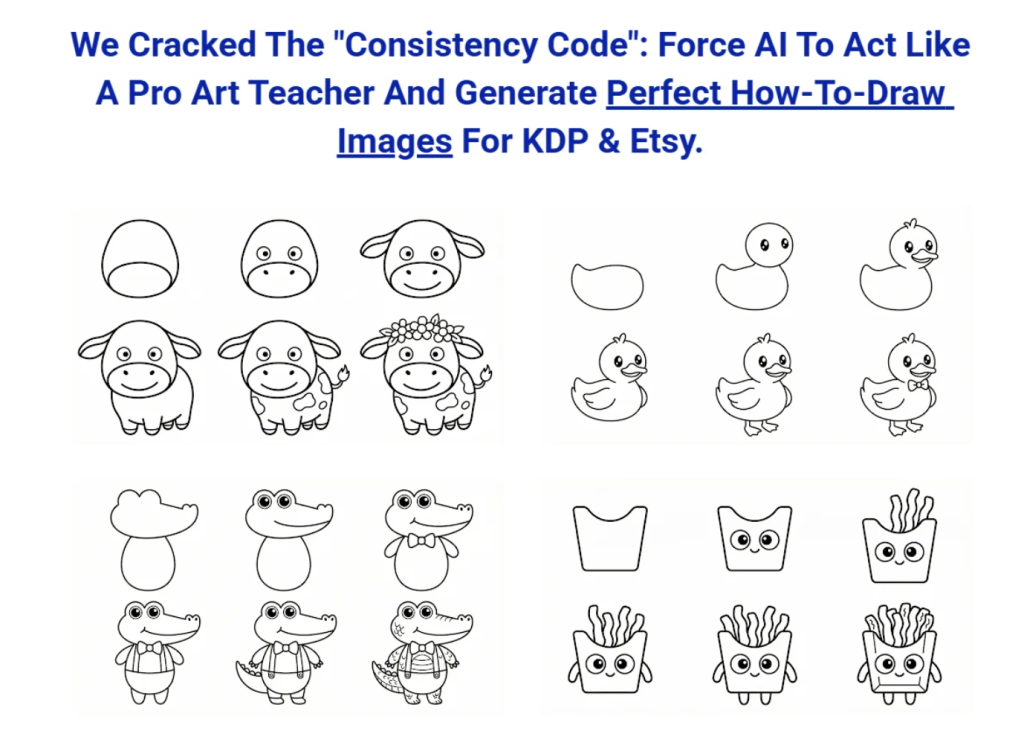
So when I encountered 323 How-To-Draw Prompts, my interest wasn’t piqued by the anonymous “Emma’s” life-changing revenue. It was snagged by the specific, technical problem the product claimed to solve: the “AI hallucination” in step-by-step drawing guides.
I had been there. I’d spent evenings in ChatGPT and DALL-E 3, trying to craft a simple, six-step tutorial for a cartoon dog. The result was always a comedic failure – a dog with three legs in step three, a cat’s face in step four, or a jarring leap from sketch to shaded portrait. The AI could not maintain “Frozen Consistency.” It didn’t understand pedagogy. This wasn’t a monetization problem; it was a fundamental production problem. If this prompt pack could genuinely crack that “Consistency Code,” then it was solving a real, frustrating barrier to entry in a proven market. That’s what led me to purchase it and put it through a rigorous, real-world workflow test.
What You Actually Get: The Core Mechanics in Practice
Let’s be clear: you are not buying software. You are purchasing access to a proprietary framework – a set of 323 architecturally engineered text prompts. Their entire value is in their specific, uncompromising design for one environment: Google’s Gemini Advanced (the paid subscription tier).


After weeks of using it to produce content for two separate KDP projects, here’s what this framework delivers in tangible terms:
- The “Invisible Grid” Protocol: Every prompt forces the AI to generate a clean, six-panel layout on a pure white background. In practice, this eliminates 90% of the formatting drudgery. You paste, you generate, and you receive a perfectly aligned worksheet template. No more manual cropping or battling inconsistent canvas sizes.
- The “Feature Freezing” Breakthrough: This is the core intellectual property. The prompts enforce an additive drawing rule. A line drawn in step one is locked. It does not morph, change weight, or disappear in steps two through six. The AI adds new lines to complete the figure. My success rate was around 95%. It’s not perfect, but it transforms the process from “impossible” to “manageable with minor curation.”
- Zero-Edit, Market-Specific Assets: The output has a deliberate “kid-friendly” aesthetic – wide-set cute eyes, simple shapes. Critically, the prompts explicitly forbid borders, step numbers, or text labels. What you download is a pristine PNG of six floating drawing steps, ready to be dragged into your Canva book template. You are generating production-ready components, not just images.
The user process is intentionally simple, which is a pro:
- Step 1: Activate a chat in Gemini Advanced (paid) and ensure the “Pro” (Thinking) model is selected.
- Step 2: Copy a prompt from the library (e.g., “How to draw a cartoon turtle in 6 steps…”).
- Step 3: Paste and generate. Await the result.
- Step 4: Download and organize into your project folder.
The complexity is all upstream, in the engineering. Your role shifts from “struggling prompt engineer” to “efficient asset manager and publisher.”
The Honest Scale: Pros, Cons, and Hard Requirements
A trustworthy review must weigh both sides. Here is my balanced assessment after integrating this tool into my actual publishing pipeline.
The Advantages (Where It Excels)
- Solves a Legitimate Technical Block: It does what it says. It provides a reliable method to generate coherent step-by-step drawing tutorials with AI, a task that was notoriously unreliable before.
- Significant Time Compression: Creating the core artwork for a 100-page drawing book went from a hypothetical multi-month ordeal to a focused weekend project.
- Democratizes Asset Creation: It removes the need for artistic skill or expensive illustration commissions. The barrier to creating a professional-looking product is now basic computer literacy.
- Offers Strategic Breadth: The 40 categories (from Dinosaurs to Vehicles to Kawaii Food) aren’t random. They are a market-informed arsenal, allowing you to create targeted books that match specific, high-demand search terms on Amazon and Etsy.
The Considerations & Limitations (What You Must Accept)
- Non-Negotiable Dependency: This product is functionally useless without an active Gemini Advanced paid subscription (~$19.99/month). The prompts are precision-tuned for its “reasoning” depth. This is a recurring operational cost you must factor in.
- Requires Quality Control: The output is not 100% flawless. Perhaps one in twenty sequences might have a slight inconsistency – a line that doesn’t quite connect. You must exercise a basic editorial eye to filter and, if needed, re-generate.
- You Supply the Business Acumen: This is a production tool, not a business-in-a-box. All the real work – market research, cover design, keyword optimization, publishing platform logistics, and marketing – remains in your hands. It solves the “content creation” bottleneck, not the “business success” equation.
- Market Dynamics are Real: The showcased success story exploits a market opportunity. As adoption of such tools grows, competition in the “how-to-draw” book niche will intensify. Your differentiation will come from branding, niche selection, and catalog quality, not just from using this tool.
Pricing, Value, and Who This Is Really For
The 323 How-To-Draw Prompts is sold as a one-time purchase digital product. It’s typically priced in the $20-$40 range, with promotions often active.
This Product is Worth Its Weight in Gold For:
- Active KDP/Etsy Publishers: Who want to efficiently expand into the evergreen children’s activity book category with a quality-competitive product.
- Digital Creators & Educators: Who need a reliable stream of kid-friendly drawing worksheet assets for printables, lesson plans, or social media content.
- The Technically-Frustrated: Who have hit the wall with standard AI’s inability to follow sequential logic and need a pre-engineered solution.
- The Process-Oriented Builder: Who sees this as a specialized component in their content production pipeline and is ready to handle the surrounding business tasks.
You Should Save Your Money If:
- You expect automated, hands-off income. This is a tool, not an autopilot.
- You are unwilling to pay for the required Gemini Advanced subscription.
- You have no interest in learning the basics of self-publishing platforms (KDP, Etsy, Canva).
- You believe buying a tool alone guarantees market success.
The value proposition is explicit: it trades a modest one-time fee for the hundreds of hours of R&D required to solve a complex AI prompting problem. For the right user, that’s an exceptional return on investment.
Final Verdict: A Specialist Tool That Delivers on a Core Promise
After thorough testing, my verdict is precise: 323 How-To-Draw Prompts is a highly effective, niche-specific tool that accomplishes its primary job with impressive reliability. It is not a magical wealth generator, but it is a professional-grade instrument that removes a significant technical roadblock.
Disregard the hyperbolic income case study. Instead, focus on the practical truth: this product successfully cracks the “consistency code” for AI-generated sequential drawings. That is a genuine technical achievement with immediate utility for content creators.
If you are seriously committed to publishing in the children’s activity space and have been stalled by the “how do I create the actual drawings?” problem, this tool will efficiently solve it. It will move you from ideation to production at a speed that was previously unavailable to non-artists.
Your ultimate success will be determined by the business framework you build around these assets. This product gives you a superior, consistent “what.” You bring the strategy, branding, and “how” to market.
For its price, it offers a legitimate key to a perennially in-demand market. In the world of digital tools, where overpromising is the norm, finding one that under-promises and over-delivers on a specific function is rare. This, in my experience, is one of them.
You might also like our roundup of the Best Ebook/PLR Library here!