
I’ve been testing AI writing tools for seven years. Long enough to develop a professional skepticism. Long enough to recognize the pattern: a product launches with big promises, you test it, and it fails at the one thing that actually matters.
With fiction writing, that one thing is continuity.
You can have beautiful prose. You can have compelling characters and an original premise. None of it matters if your spaceship’s FTL drive works differently in chapter twelve than it did in chapter three. None of it matters if your protagonist’s backstory shifts halfway through the book. None of it matters if your AI character suddenly starts talking like a different person.
Readers notice. They stop reading. They leave bad reviews. Your series dies.
I know this because I’ve lived it. I’ve abandoned more projects than I’ve finished. Not because I couldn’t write, but because I couldn’t keep track of everything. The complexity of a multi-book universe eventually crushed me every single time.
So when I heard about. 337 Prompts for Sci-Fi Sagas – a system that claims to solve AI’s memory problem for good – I paid attention. Not because I believed the hype. But because if it actually worked, it would solve the single biggest obstacle to writing long-form fiction with AI.
I’ve spent the last few days testing it extensively. Here’s what I found.
The Real Problem With AI Writing
Here’s the dirty secret of AI-assisted writing: regular ChatGPT has the memory of a goldfish.
You can have a great conversation where it helps you build detailed characters and intricate plot lines. You close the chat. You come back tomorrow. It remembers nothing.
Even within a single session, it starts drifting after a few thousand words. Character traits shift. Technology rules bend. Plot points get contradicted.
This isn’t the AI’s fault. It’s how the technology works. Large language models don’t have permanent memory. They have context windows. Once that window fills up, older information starts falling out.
For short-form content, this is annoying but manageable. For a nine-book sci-fi saga? It’s catastrophic.
I’ve tried every workaround. Custom instructions. Long reference documents pasted into every session. Spreadsheets tracking every detail. Nothing worked consistently because nothing forced the AI to actually check those references.
That’s what makes the approach behind 337 Prompts for Sci-Fi Sagas different.
If you want to understand why this matters for your own writing, you can see the full system here.
What This Product Actually Does
Let me be clear about what this is.
It’s a collection of 337 prompts designed specifically for ChatGPT. But calling them “prompts” undersells what’s happening. These aren’t simple requests like “write a story about a spaceship.” They’re engineered instructions that fundamentally reshape how the AI behaves.
The core innovation is what they call the Galactic Archive.
Here’s how it works in practice:
You pick one of 48 sci-fi tropes – “Ragtag crew of outcasts”, “Awakening cosmic entity”, “Decaying galactic empire”. You paste a prompt into ChatGPT. The AI generates a complete universe bible. Not a paragraph. A full document containing factions, technology rules, character psychological profiles, and a nine-book macro outline.
That document becomes a permanent reference file that you upload to a Custom GPT.
Then, every time you use the system to outline a book or write a scene, the AI is forced to check that file first. It literally cannot generate anything without verifying it against established canon.
When you finish a book, you run the Canon Lock prompt. This generates an update file recording everything that happened – ships damaged, relationships changed, secrets revealed. You upload that file. Now the AI remembers for book two.
It’s like having an assistant who never forgets anything you’ve ever told them.
Testing It: What Surprised Me
I started with the “Abandoned megastructure” trope because it’s something I’ve tried to write before and failed.
The Saga-Builder prompt generated an Archive that included:
- A decaying Dyson sphere built by a vanished species
- Three competing factions trying to access it
- A protagonist with a specific psychological wound
- Technology rules banning teleportation and infinite energy
- Nine-book escalation from exploration to galactic war
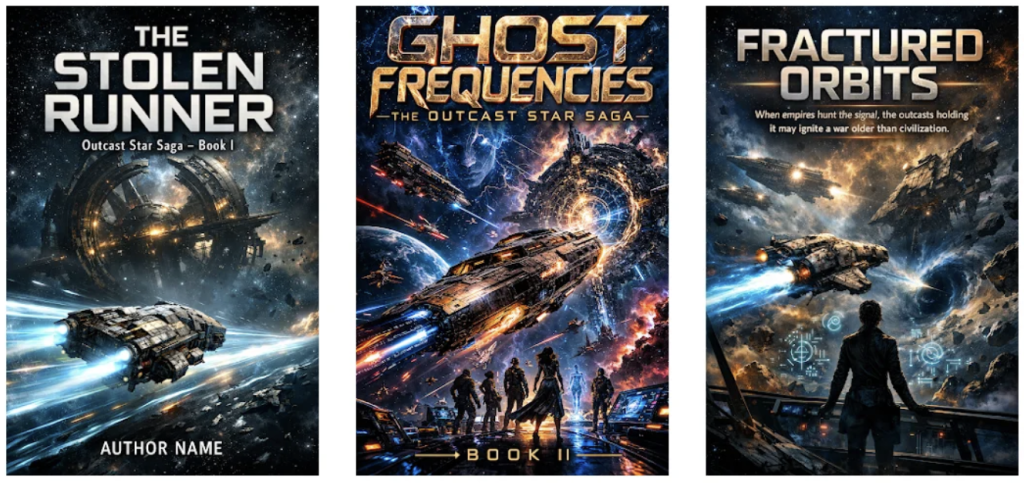
The Book prompt generated a 13-page chapter outline, an Amazon description, SEO keywords, and a cover prompt. I ran that cover prompt through Midjourney. The image was genuinely publishable.
The Page prompt generated the first scene. Here’s what surprised me: the prose had texture. The environment had smell and sound. The technology had cost – when they powered up ancient systems, something overheated and they lost life support. The character spoke with a consistent voice.
I kept waiting for the AI to hallucinate. To forget the protagonist’s name. To introduce a magical solution that broke the rules.
It never happened.
Not once across multiple test scenarios.
The cover prompts alone are worth looking at if you’re tired of generic AI art.
The Psychological Depth
One thing I didn’t expect was how well the system handles character psychology.
The prompts force the AI to build protagonists with:
- Core wounds that drive their decisions
- Private fears they never admit to others
- Specific flaws that create leadership friction
- Growth arcs mapped across all nine books
For example, in the Archive generated from my test, the captain had a “control obsession” stemming from a past betrayal. The pilot had “responsibility avoidance” from being abandoned by family. The AI character had “uncertain ethics” from memory corruption during self-liberation.
These aren’t surface-level traits. They actually affect how characters respond to situations. When the crew faced a mutiny threat, the captain’s control obsession made her overreact. When someone needed to sacrifice for the group, the pilot’s avoidance instinct made him hesitate.
This kind of psychological consistency is rare in AI-generated fiction. Usually characters are interchangeable. Here, they feel like distinct people with internal lives.
The Technology Rules That Matter
Hard sci-fi readers are a demanding audience. They notice when technology is inconsistent. They notice when problems get solved by magic.
The prompts enforce strict technology constraints:
- No infinite energy sources
- No teleportation without infrastructure
- No resurrection technology
- FTL travel requires preparation and fuel
- Weapons cause real damage with political fallout
Every action has a visible cost. When a ship jumps through slipstream, the reactors drain. When weapons fire, hull stress accumulates. When ancient technology activates, something degrades or breaks.
This forces the AI to write scenes with genuine tension. Characters can’t just wave a hand and fix everything. They have to work within limitations, make sacrifices, and accept consequences.
The Nine-Book Architecture
Most writers struggle to plan a single book. Planning nine interconnected books is a different level of complexity.
The system provides a macro-outline structure that ensures:
- Each book escalates the stakes
- Character arcs progress naturally across volumes
- Mysteries unfold at a satisfying pace
- Every book ends with a hook that makes readers want the next one
The sample in their documentation shows a nine-book arc that moves from “crew steals a ship” in book one to “galaxy-changing consequences” in book nine. Each installment has a clear purpose. No filler. No sagging middle volumes.
This is the difference between writing a series and just writing a long book chopped into pieces.
The Honest Pros and Cons
What Works Well
The continuity system is genuinely effective. After testing this, I trust that the AI won’t contradict itself. That peace of mind is the entire point.
The variety is real. I tested prompts from different categories and got genuinely distinct universes. No reskins.
The Book prompt output is complete. Having an Amazon-ready description and SEO keywords saves hours. The cover prompts alone justify the price.
The learning curve is gentle. If you can copy and paste, you can use this. The included guide walks you through every step.
The psychological depth in character creation is impressive. Your characters actually feel like people.
What Could Be Better
You need ChatGPT Plus. Custom GPTs aren’t available on the free tier. That’s an ongoing cost to factor in.
The output quality depends on following the system. If you skip steps or ignore the Archive updates, the AI will eventually drift. This requires consistent maintenance.
The prose benefits from human editing. The AI gives you an 80% solution. The final 20% – sharpening dialogue, adjusting pacing – is still on you.
Some of the 48 categories overlap. The variety is still substantial, but it’s not 48 completely distinct flavors.
The system is optimized for novella-length books (15,000-20,000 words). If you want 100,000-word epics, you’ll need to adapt the approach.
Who This Is For
This is for you if:
You want to write a sci-fi series but feel overwhelmed by world-building complexity. The system handles the heavy lifting so you can focus on writing.
You’ve tried AI writing but got frustrated by continuity errors. This solves that specific problem.
You understand that tools multiply your effort rather than replacing it. If you’re willing to edit and refine, this will multiply your output dramatically.
You want to test market ideas quickly. Producing a polished Book 1 in days rather than months means you can validate concepts before committing to a full series.
Skip this if:
You want a “push button, get money” solution. This won’t write books while you sleep.
You hate following instructions. The system works because it has rules. Ignore them and you’ll break it.
You don’t write sci-fi. The prompts are engineered specifically for this genre.
You’re not willing to pay for ChatGPT Plus. The subscription is real and necessary.
The Value Analysis
The price is $17 at launch.
Here’s what you’re buying:
Time. Building a coherent universe bible used to take weeks. Now it takes minutes. Outlining a book used to take days. Now it takes seconds.
Mental load. Worrying about continuity consumed energy I could have spent on actual writing. Now that energy is freed.
Skill replacement. Good cover designers charge hundreds. The cover prompts alone generate art that would cost you real money. Good editors charge thousands. This system doesn’t replace editors, but it reduces the editing burden by maintaining continuity automatically.
For someone serious about building a publishing business, the math is straightforward. One book produced faster than you could otherwise manage pays for this many times over.
The Strategy Most Reviews Miss
A single book is a liability. A series is an asset.
A standalone novel requires constant marketing. You’re always hunting for new readers. Stop promoting, sales die.

A nine-book series with strong continuity becomes self-sustaining. Readers discover book one, get hooked, and buy the rest automatically. Your backlist works while you sleep.
This system is designed for that asset-building approach. The nine-book macro outline ensures every installment ends with a hook. The technology constraints keep stakes high. The character arcs create emotional investment.
If you’re thinking about this as a way to write one book, you’re missing the point. The value is in the series. The value is in becoming the author that sci-fi readers trust to deliver a complete experience across dozens of hours of reading.
You can grab it here if that kind of long-term thinking matches your goals.
Final Verdict
337 Prompts for Sci-Fi Sagas does what it claims. It gives you a system for building coherent, multi-book sci-fi universes with AI assistance. The continuity technology works. The output quality is genuinely good. The workflow, once set up, is smooth.
It’s not magic. You still need to write, edit, and publish. You still need to understand your market. The tool doesn’t replace you – it amplifies you.
But for the specific goal of writing a sci-fi series faster and with fewer headaches? This is the most focused, well-executed solution I’ve seen in years.
If you’re serious about building in this genre, it’s worth your attention.
I tested this product extensively after launch. All opinions are my own based on actual usage. Your results depend on your effort, skill, and market understanding. No income claims are made or implied.
You might also like our roundup of the Best Image/Video AI Tools here!