
If you’ve ever tried to create a coloring book using AI image generators, you already know the feeling.
You sit down with a clear idea. You type something simple like “cute forest animals playing in a meadow.” What comes back is either a photorealistic mess with weird shadows, something so simple it looks like a five-year-old drew it, or an image that somehow has gray smudges where clean black lines should be.
You tweak the prompt. You add “coloring book style” and “black and white” and “bold lines”. The result improves slightly, but now the composition is boring. One character. No story. No scene that a child would actually want to sit with for twenty minutes.
Two hours later, you have maybe three usable images. You need thirty for one book.
I spent the better part of last year in this exact loop. I was building coloring books for Amazon KDP, trying to scale a side project that made sense on paper but felt impossible in practice. The AI tools were powerful, but the gap between “powerful tool” and “consistent, publishable output” was costing me weeks of work.
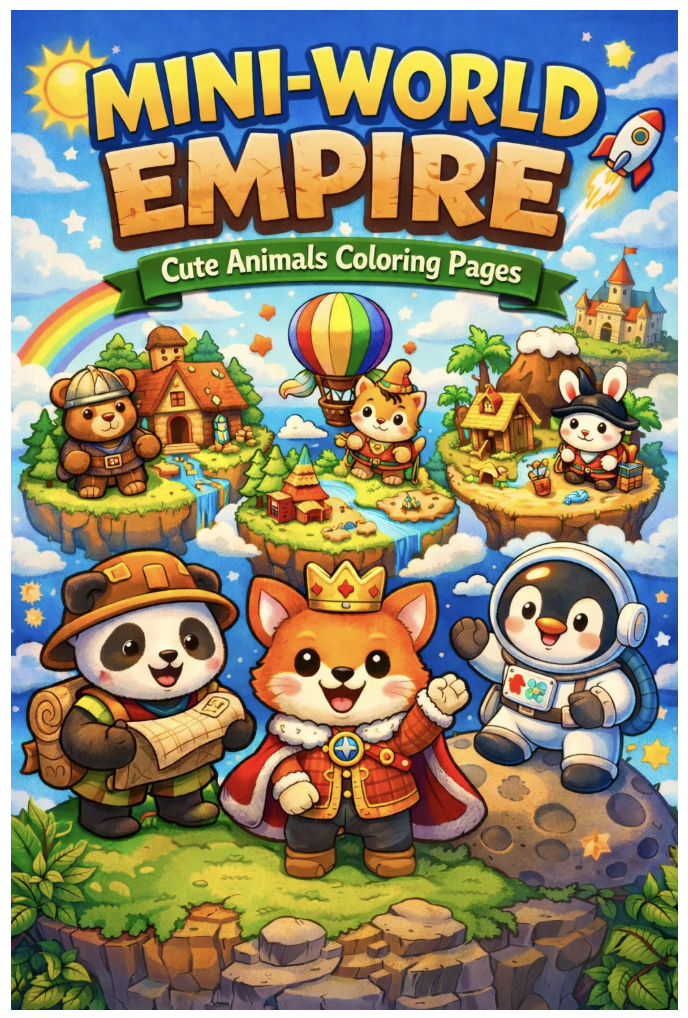
When I heard about Mini-World Empire – a pack of 500 prompts launched only a few days ago – I was skeptical. I’ve bought prompt packs before. Most are just lists of keywords someone threw together. But the description mentioned something that caught my attention: narrative depth. Actual scenes with characters, relationships, and story arcs built into each prompt.
That was different enough to make me take a closer look.
What Mini-World Empire Actually Does (And Why It Matters)
Let me skip the marketing language and tell you what you’re getting.
Mini-World Empire contains 500 prompts, each designed to generate a complete coloring book scene – not just a single character or a simple object. The prompts are organized into 20 distinct worlds. Think Mushroom Village, Ocean & Underwater, Enchanted Forest, Space & Starry Night, Farm & Countryside, Magical Garden, Snowy Winter Village, and more. Each world has 25 scenes that cover different moments: morning routines, community gatherings, individual adventures, humorous situations, moments of tension or wonder.

What makes this different from a generic prompt list is that every scene is built to tell a small story.
One prompt I generated created a scene of a squirrel detective examining a tiny footprint outside a mushroom door. Another showed a group of underwater creatures running a coral reef market. A third depicted a group of mice hosting a lantern festival in an underground cave. These aren’t random images. They have personality and narrative hooks that make kids want to color them.
When I tested the first few prompts in MidJourney and Nano Banana 2, the results came out clean on the first try. Bold outlines. White background. The right level of detail for kids aged 9 to 12 – detailed enough to be engaging, not so detailed that it becomes frustrating.
That alone saved me hours of prompt engineering.
If you want to see what the actual output looks like, you can check the official page here.
My Real Experience Using Mini-World Empire
I work in batches. When I’m building a coloring book, I usually set aside two days to generate all the images. Before this pack, those two days were mostly troubleshooting. After, they became actual production.
The onboarding was simple. You get a spreadsheet with 500 prompts. Copy, paste into your AI tool of choice, generate. No special setup. No complicated workflows.
The learning curve was essentially zero. The prompts are written in a format that works across MidJourney, Nano Banana 2, ChatGPT Images, and Leonardo. I tested them in three different tools and got consistent results each time.

What surprised me – genuinely – was how usable the first-generation outputs were. In my experience, most prompts require multiple rounds of tweaking. You run it once, adjust, run it again, adjust again. With Mini-World Empire, maybe one in ten needed a small adjustment. The rest were ready to drop straight into a book layout.
What also surprised me was the variety. I expected 500 variations of the same basic idea. Instead, each world feels distinct. The Enchanted Forest scenes don’t look like the Beach & Seaside scenes. The characters in the Pumpkin Patch & Harvest set have a different energy from the Snowy Winter Village set.
I found myself generating images for two books simultaneously – one autumn-themed and one underwater-themed – without feeling like I was repeating content.
The only downside? If you’re looking for toddler-level simplicity, these aren’t it. The prompts are calibrated for ages 9 and up, with enough detail to keep older kids and adults engaged. For younger children, you’d need to simplify some of the scenes manually.
What Makes This Worth Paying For
Here’s where I want to be honest with you.
I’ve bought prompt packs before that felt like someone spent an afternoon typing keywords into a spreadsheet. Those packs usually sit untouched in my Google Drive. This one didn’t.
The difference is in how the prompts are structured. Each one includes technical parameters for clean, print-ready output. But more importantly, each one has a narrative hook. That means when you generate an image, you’re not just getting a generic “cute fox.” You’re getting a fox trying to bake a pie that’s too big for its oven. Or a fox teaching a group of younger animals how to read a map.
Those details matter because they turn a coloring page into something a child (or adult) actually wants to spend time with. And in a market flooded with generic AI coloring books, that’s what makes a book stand out.
If you’re creating coloring books for Amazon KDP, Etsy, or any other platform, the difference between a book that sells and a book that sits is often the quality of the scenes inside. These prompts give you a head start that would otherwise take weeks to develop on your own.
Check current pricing and availability here!
Pros and Cons (No Sugarcoating)
Pros
- 500 prompts organized into 20 complete worlds, each with narrative cohesion
- Images generate clean on the first try in most major AI tools
- Bold outlines, white backgrounds, print-ready parameters built in
- Covers commercially proven niches – seasonal, cozy, whimsical, adventurous, fantasy
- Full commercial license: you own the images you create, can publish and sell freely
- Works for both the children’s market (9-12) and adult coloring market simultaneously
- Includes a bonus training video on publishing to Amazon (from book creation to cover design to submission)
- Includes a Prompt Rewriter GPT to generate unique variations if you want to avoid duplicate prompts
Cons
- Not suitable for toddler-level coloring pages – complexity is calibrated for ages 9 and up
- You cannot resell the prompts themselves (only the images you generate)
- Requires access to an AI image tool like MidJourney, Nano Banana 2, or ChatGPT Images (not included)
- If you’re brand new to AI image generation, you’ll need about 30 minutes to get comfortable with the tool interface
Pricing and Value Analysis
The pack is currently priced at $17.
Let’s put that in perspective.
When I was writing my own prompts, I spent roughly 10 to 15 hours per book on prompt engineering alone. At a modest freelance rate, that’s $150 to $225 in time cost per book. The $17 price is less than what I’d pay for one hour of my own time.
If you use each prompt once, you get 500 unique scenes. That’s enough content for 20 standalone coloring books (at 25 scenes per book). Use them multiple times with variations, and you’re looking at 50 to 100 books worth of material.
The time-saving argument alone makes the price reasonable. But there’s also the creative angle. Even if you’re a skilled prompt writer, coming up with 500 distinct narrative scenes across 20 different themes is a massive creative lift. That work is already done for you.
Who this is perfect for:
- People creating coloring books for Amazon KDP, Etsy, Gumroad, or other platforms
- Designers using AI as a production tool to scale output
- Anyone who values structured, ready-to-use systems over scattered ideas
- Creators targeting the 9-12 children’s market or adult coloring market
- Anyone tired of spending hours tweaking prompts and getting inconsistent results
Who should skip this:
- People looking for extremely simple toddler line art
- Those who don’t have access to or don’t want to use AI image tools
- Creators who only want to make one coloring book and never revisit the space (though even then, $17 is still a reasonable cost for the time saved)
The Decision Factor
Here’s what stopped me from buying prompt packs in the past.
I always wondered: What if these prompts don’t work with my preferred AI tool? What if the images come out looking like everything else on the market? What if I spend $17 and never use it?
Those questions are valid. I’ve asked them myself.
With Mini-World Empire, the risk is significantly lower because of three things:
- The prompts are tested across multiple tools (MidJourney, Nano Banana 2, ChatGPT Images, Leonardo)
- The narrative depth means your output won’t look like generic AI coloring pages
- There’s a 14-day money-back guarantee
That last one matters. If you generate a few scenes and decide it’s not for you, you can get a full refund. No questions asked.
The creators – Alessandro Zamboni and Alex Bellian – have clearly put weeks of testing and refinement into this pack. It shows in the consistency of the outputs and the thoughtfulness of the scene selection.
If you’re on the fence, I’d suggest grabbing it while the launch price is still active. The creators have mentioned the price will increase after the launch period, and based on the quality of what’s inside, I believe them.
Final Verdict
I’ve tested enough tools and prompt packs to know the difference between something that’s been carefully engineered and something that was thrown together quickly.
Mini-World Empire falls into the first category.
The prompts are clearly the result of someone who has spent time in the AI coloring book space, understands the technical requirements for clean outputs, and values narrative quality over quantity. The fact that each world has 25 scenes with morning, evening, community, and individual moments shows thoughtfulness that’s rare in this market.
For me, the decision came down to one question: is this going to save me more than a few hours of work? The answer was yes. And after using it, the time saved has already paid for itself several times over.
If you’re currently building coloring books with AI, or planning to start, this pack removes the hardest part of the process – consistent, quality, narrative-driven scenes that actually look like coloring books. No more hours of prompt tweaking. No more creative block wondering what scenes to create next. Just generate, compile, and publish.
The 14-day refund guarantee means you can try it without risk. If it doesn’t work for your workflow, you’re covered.
You might also like our roundup of the Best Image/Video AI Tools here!